Roofing in Long Beach, where the first three blocks are all one age
Long Beach has a sharp line through it. Katrina destroyed almost every building within 1,600 feet of the shoreline, and the rebuilt strip behind the beach is a different proposition from the town a few blocks north of it.
Incorporated in 1905 and once known as the Radish Capital of the World, Long Beach now has 17,309 residents, 65.7 per cent owner-occupancy and a median build year of 1986 — a figure that averages a nearly new beachfront strip with substantially older housing inland. Standing on any street running north from the water, you can see the transition.
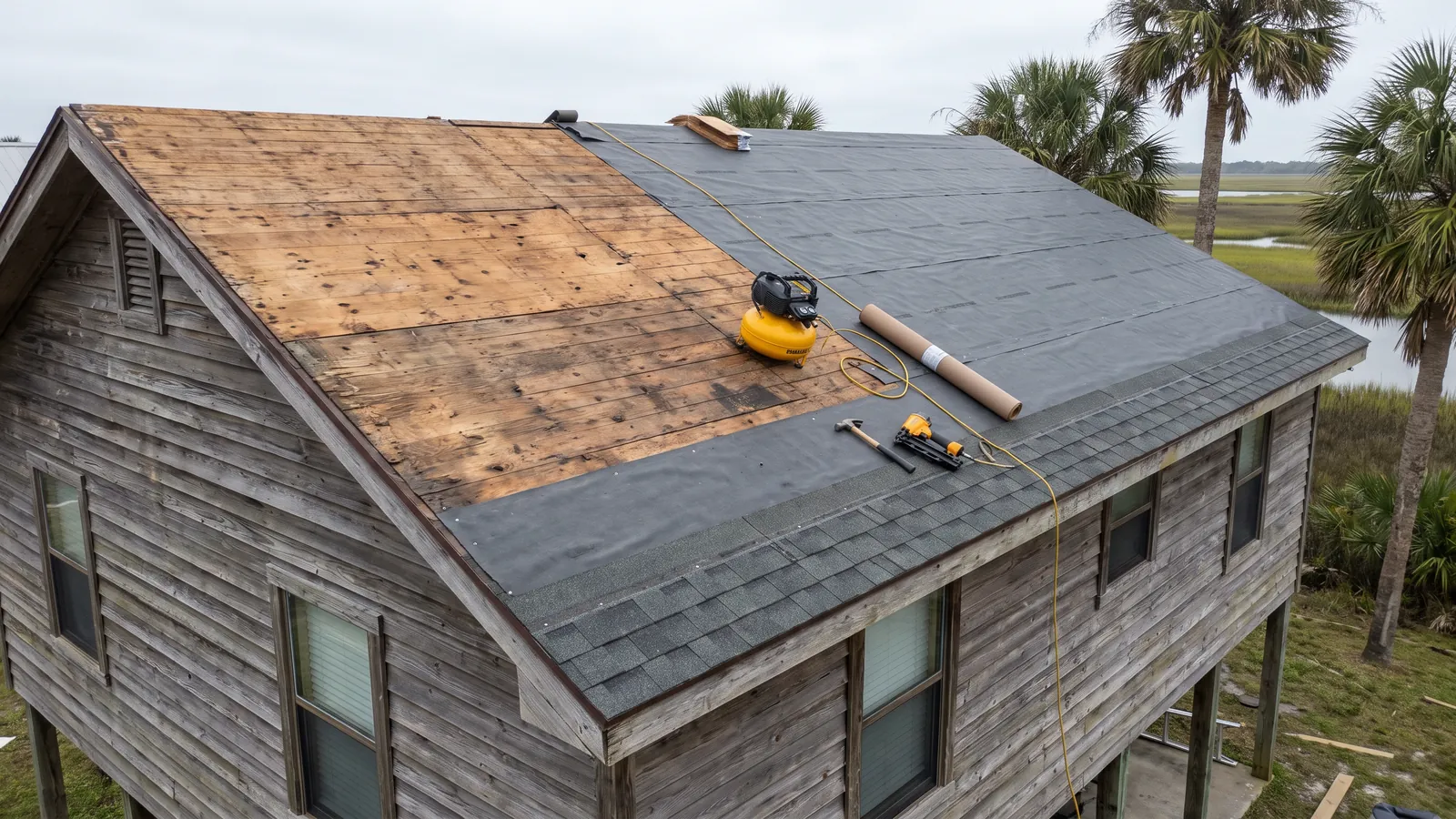
South of that line, the housing went up after 2005 under the post-Katrina code, much of it raised on piers to satisfy flood requirements. Those roofs have correct deck nailing and proper edge detail, and they are now around twenty years old, which is the end of an architectural shingle on this coast. A raised house also means a longer ladder, more wind exposure at roof level, and genuinely more care about access — it is a different working proposition from a slab-on-grade house a mile inland, and an honest quote reflects that.
North of it, the stock survived and dates from the decades before. Those roofs predate HB 1406 and the wind provisions it brought to the coastal counties, so a tear-off usually reveals decking fastened to a lighter schedule than the code now wants and edge detail that was never specified for uplift at all. Correcting both is routine and should be priced rather than discovered.
Wind exposure here is as high as anywhere we work. There is nothing between a beachfront roof and the Sound, which puts the perimeter and corner zones under pressure that an inland specification does not anticipate. That is the argument for FORTIFIED detailing in this town specifically: a sealed deck matters most exactly where the covering is most likely to leave.
What we do in Long Beach
Raised houses worked properly
Pier-built beachfront homes need different access and more care at roof level, and the quote says so rather than discovering it.
Twenty-year rebuild roofs
The post-Katrina strip is reaching the end of its first shingle, usually on a sound deck that makes for a clean job.
Pre-2005 decks brought up
Inland roofs that predate the wind provisions get their nailing and edge detail corrected at tear-off.
Perimeter uplift detailing
Enhanced edge and corner fastening, because there is nothing between a Long Beach roof and the Sound.
FORTIFIED where it earns most
A sealed deck matters most where the covering is most exposed, and that is this town.
Salt-rated fixings throughout
Stainless or properly coated, because ordinary fixings this close to the water fail before the roof does.
Neighbourhoods and roads we cover
- The beachfront strip along US 90
- The rebuilt raised houses south of the railway
- Downtown Long Beach and the harbour area
- The older neighbourhoods north of the CSX line
- Streets around the university campus area
- Subdivisions north toward the Pass Christian boundary
- Klondyke and the northern residential areas
- Commercial buildings along the highway corridor
Roofing services in Long Beach
- Roof repair, leak tracing, storm damage, emergency call-outs and tarping
- Full replacement, Class H shingle, metal roofing and FORTIFIED upgrades
- Inspections, insurance documentation and claim support
- Flat and low-slope, commercial, gutters and soffit and fascia
Questions from Long Beach homeowners
My house is raised on piers. Does that change the job?
Yes, in access and in exposure. The roof is higher, the wind at that level is stronger, and getting materials up takes longer and needs more care. It is a legitimate reason for a quote to be higher than for the same roof area on a slab-on-grade house, and an honest quote will say that rather than discovering it on the morning.
Everything near the beach went up at once. Does that matter?
It means a lot of roofs in the same three blocks reach the end of their life within a couple of years of each other. The upside is that those roofs sit on post-Katrina decks with correct nailing, so the tear-off is usually clean and the job is predictable.
Is my inland Long Beach roof different?
Usually older and built before the coastal wind provisions, so a tear-off tends to find decking nailed to a lighter schedule and edge detail that was never specified for uplift. Both get corrected as part of the work; both should appear in the quote rather than as a surprise.
Is FORTIFIED worth it this close to the water?
This is the town where the argument is strongest. The sealed deck means that if the covering does leave in a storm, the structure still sheds water — which is exactly the scenario a beachfront roof faces. The grant runs to $10,000 and the guide covers eligibility.
Do I need a permit in Long Beach?
Rules vary by municipality along this coast and Long Beach is not Gulfport. We establish the current requirement with the city before the job rather than assuming either way, and the permit, where one is needed, is pulled as part of the work.
Nearby: Pass Christian · Waveland · Bay St. Louis · full service area