Shingles were never going to work on that porch
Most flat-roof problems on this coast are on a section that is not really a roof in its own right — a porch, a carport, an addition built onto a pitched house — and the trouble usually started with the wrong material being put on it.
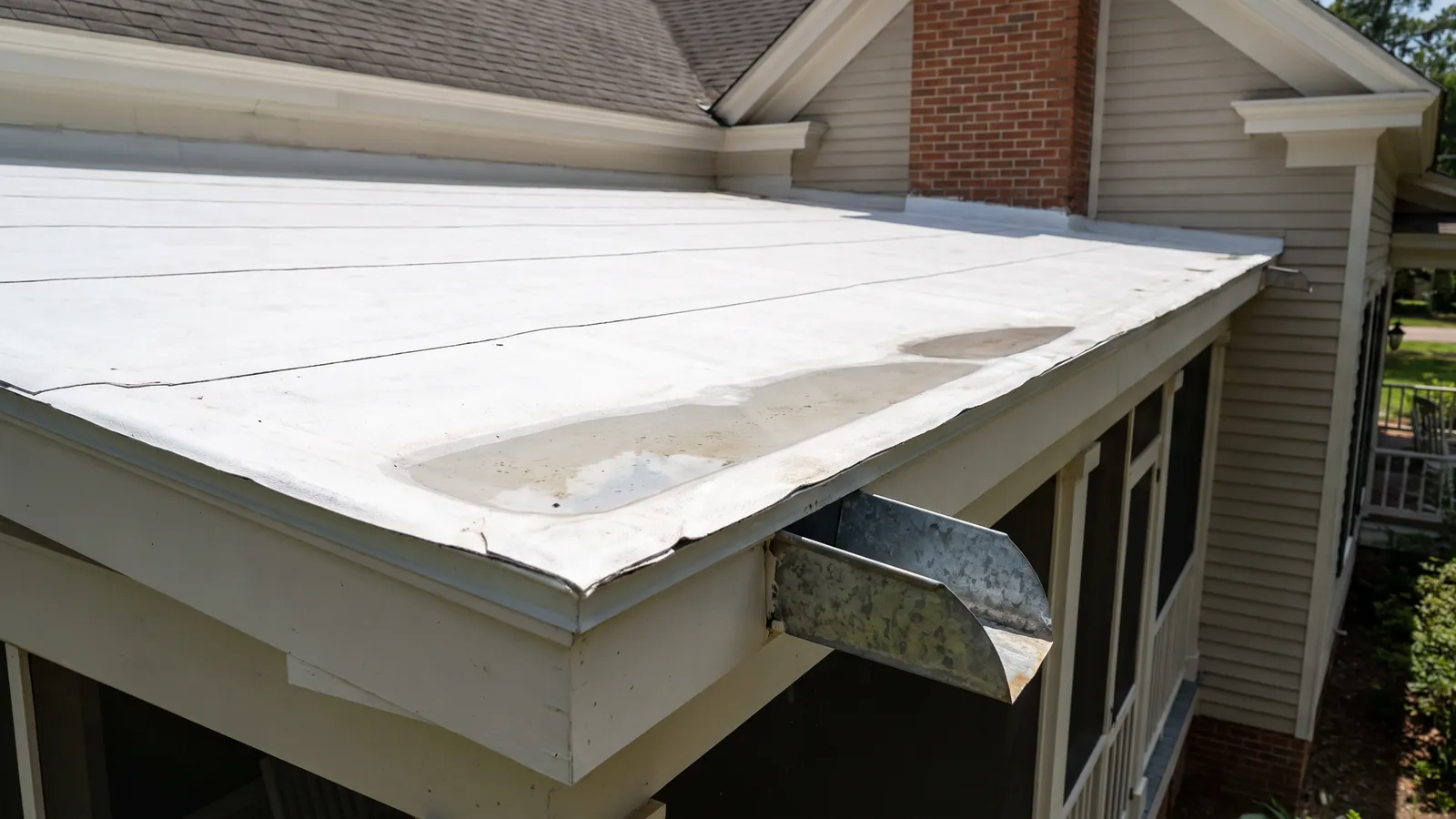
The fundamental point: a flat roof is not flat and must not be. It needs fall, typically a quarter-inch per foot, to move water to a drain or a scupper. A roof that ponds — holds standing water more than a couple of days after rain — is being asked to be waterproof rather than water-shedding, and every seam, flashing and penetration is then under permanent hydrostatic pressure. In this rainfall that is a losing arrangement, and it is why ponding is the first thing we look at.
What should be on there. TPO is a single-ply membrane, heat-welded at the seams so the joint is as strong as the sheet, typically white so it reflects a great deal of the heat that would otherwise cook the space below. It is the default for low slope here and for good reason. Modified bitumen, torch or self-adhered in multiple plies, is tough and forgiving and suits small awkward areas. EPDM, the black rubber one, performs well but absorbs heat, which is a real consideration over a Mississippi porch. What should not be on there is shingles — below about a 2:12 pitch they simply cannot shed fast enough and water gets under them, yet we see it constantly on porch additions where somebody continued the main roof covering across a slope it was never rated for.
Where they fail. Seams first, particularly on older mechanically-fastened or adhered systems where the lap was never properly welded. Then flashing at the wall, where a low roof meets the main house — this needs a proper counterflashing tucked into or over the wall covering, and a bead of sealant where that should be is a leak with a date on it. Then penetrations, then drains and scuppers blocked with leaves and granules, which converts a working roof into a pond.
Finding the leak. Harder than on a pitched roof, because water travels between the membrane and the deck and can emerge anywhere. Ponding marks, blisters and soft spots underfoot narrow it down. Where it will not, a moisture scan finds trapped water in the insulation and shows the extent of what is wet, which also tells you whether a patch is viable or whether the insulation under a whole section has to come out.
What's included
Fall checked first
Ponding is a design fault, not bad luck. If water stands for days, that gets addressed rather than patched around.
Seams heat-welded
TPO repairs welded so the joint is as strong as the sheet, rather than taped or glued and hoped for.
Wall flashing done properly
Counterflashing tucked in or over the wall covering, because a bead of sealant at that junction is a dated leak.
Drains and scuppers cleared
Blocked outlets turn a working low-slope roof into a pond, and clearing them is often half the repair.
Moisture scan where needed
To find trapped water in the insulation and establish whether a patch is viable at all.
Shingles on low slope corrected
Where a porch has had shingles continued onto a pitch they were never rated for, that gets said rather than patched.
Flat and low-slope roofing prices on the Mississippi coast
| Job | Typical price | Notes |
|---|---|---|
| Inspection with photographs | $0 – $195 | Free when the repair follows |
| TPO seam repair | $380 – $880 | Heat-welded, per run |
| Membrane patch, localised | $420 – $960 | Welded patch over a puncture or split |
| Wall flashing and counterflashing | $620 – $1,600 | Where the low roof meets the house |
| Drain or scupper repair | $340 – $780 | Per outlet, including clearing |
| Moisture scan | $280 – $560 | Maps trapped water before a decision |
| TPO replacement, small porch roof | $3,200 – $7,500 | Tear-off, insulation, new membrane |
| TPO replacement, larger section | $8,000 – $18,000 | By area and insulation specification |
These are 2026 ranges for Harrison, Hancock and Jackson counties, to give you something to plan around. The real figure comes after someone has been on the roof, with the scope, the permit and the inspections itemised; written estimates hold for 30 days.
Recent work
Questions we get about flat and low-slope roofing
Why does water stand on my flat roof?
Because it has lost its fall, or never had enough. A low-slope roof needs around a quarter-inch per foot to drain. Decking sags over time, insulation compresses, and additions are sometimes built nearly level from the start. Standing water more than forty-eight hours after rain is a defect, and it puts every seam under permanent pressure.
Can you patch it or does the whole thing need doing?
Depends on what is under the membrane. A single puncture on a sound roof is a welded patch. Where a moisture scan shows the insulation is wet across a wide area, a patch seals the surface over a layer that is already rotting the deck beneath it — that section has to come out. The scan is what settles it.
Why does my porch roof leak when the main roof is fine?
Almost always because the porch is low-slope and has shingles on it. Below roughly a 2:12 pitch shingles cannot shed water fast enough and it works back under the courses. It is one of the most common faults we find on additions here, and the fix is the right material rather than more sealant.
Is TPO better than rubber?
For this climate, generally yes. TPO is heat-welded rather than glued at the seams, which makes a stronger joint, and it is usually white, which reflects a great deal of heat that black EPDM absorbs and passes into the room below. EPDM is a perfectly good membrane; it is just a worse fit for a Mississippi summer.
How long does a flat roof last here?
A properly installed and drained TPO roof, fifteen to twenty-five years. One that ponds, considerably less, because standing water and UV together are the two things that age a membrane fastest. Clearing drains twice a year is the cheapest life extension available.
Does a flat roof need a permit in Gulfport?
The same rules apply as to any reroof: the city requires a permit on every re-roofing project, with repairs of one square or less treated as maintenance. A porch membrane replacement is a reroof. Urban Development is on 228-868-5715.